Postmark is an email delivery service that businesses use to send and receive transactional and broadcast emails through an API or SMTP. It provides tools to manage servers, sending domains, templates, and message streams, and to track the delivery, opens, clicks, and bounces of emails.
Hevo uses the Postmark API to replicate the servers, domains, sender signatures, templates, message streams, outbound and inbound messages, bounces, suppressions, and email statistics of your Postmark account to the Destination of your choice. To ingest data, you must provide Hevo with an Account API token. Hevo uses this token to list the servers in your account and reads the data of each server with that server’s own API token, which Postmark returns with the server details. Hevo does not store the server API tokens.
Supported Features
| Feature Name | Supported |
|---|---|
| Capture deletes | Yes, for the Server, Domain, Sender Signature, Template, Message Stream, and Outbound Statistics objects |
| History mode | No |
| Custom data (user-configured tables & fields) | No |
| Data blocking (skip objects and fields) | Yes |
| Resync (objects and Pipelines) | Yes |
| API configurable | Yes |
Prerequisites
-
An active Postmark account exists from which data is to be ingested.
-
You are an Account Owner or Account Admin in Postmark, as only these users can access the Account API tokens.
-
An Account API token is available to provide Hevo access to your Postmark account data.
-
Open tracking and link tracking are enabled on your servers or messages, if you want to ingest the open and click events of your outbound messages. Read How does open tracking work?.
Obtain the Account API Token
Postmark provides two types of API tokens: Account API tokens, which give access to account-level data such as servers, domains, and sender signatures, and Server API tokens, which give access to the data of one server. Hevo needs only an Account API token. Hevo uses it to get the Server API token of each server in your account. Read API overview.
Perform the following steps to obtain the Account API token:
-
Log in to your Postmark account as an Account Owner or Account Admin.
-
In the top navigation bar, click Account, and then click the API Tokens tab.

-
In the Account API tokens section, copy the token. If your account has no Account API token, click Generate another token to create one, and then copy it.
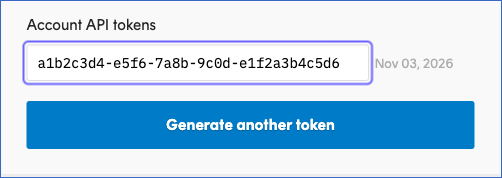
Use this token when configuring your Postmark Source in Hevo. The token remains available on the API Tokens tab, so you can copy it again later. If you delete the Account API token configured in the Pipeline, Hevo cannot authenticate with Postmark, and all active jobs of the Pipeline fail. To resume data replication, modify the Source configuration in the Pipeline with a valid Account API token. Once the updated token is saved, Hevo re-authenticates the Source, and data ingestion resumes from the last saved position.
Note: Treat the Account API token as a secret. It provides access to all the servers in your Postmark account.
Configure Postmark as a Source in your Pipeline
Perform the following steps to configure your Postmark Source:
-
Click Pipelines in the Navigation Bar.
-
Click + Create Pipeline in the Pipelines List View.
-
On the Select Source Type page, select Postmark.
-
On the Select Destination Type page, select the type of Destination you want to use.
-
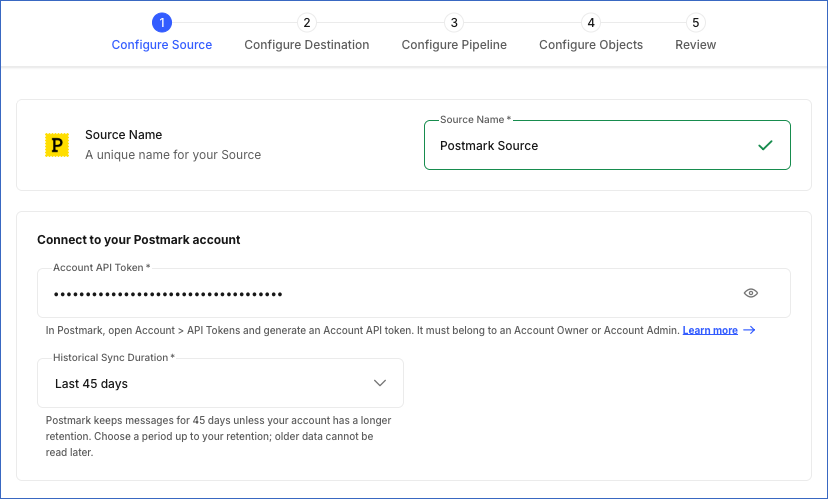
In the Configure Source screen, specify the following:
-
Source Name: A unique name for your Source, not exceeding 255 characters. For example, Postmark Source.
-
In the Connect to your Postmark account section:
-
Account API Token: The Account API token that you obtained from your Postmark account.
-
Historical Sync Duration: The period for which Hevo ingests messages, bounces, and suppressions in the first run of the Pipeline. From the drop-down, select one of the following: Last 45 days, Last 90 days, Last 180 days, or Last 365 days. Default value: Last 45 days. Postmark keeps messages for 45 days unless your account has a longer retention. Select a period up to the retention period of your account, as older data cannot be ingested later.
Note: You cannot change this value after the Pipeline is created.
-
-
-
Click Test & Continue to test the connection to your Postmark Source. Once the test is successful, you can proceed to set up your Destination.
When you click this button, Hevo performs the following validations:
-
The Account API token is valid. Hevo checks this by listing the servers in your Postmark account.
-
Hevo can read the data of the first server in your account with its Server API token.
-
Data Replication
Hevo replicates data for all the objects selected on the Configure Objects page during Pipeline creation. By default, all supported objects and their available fields are selected. However, you can modify this selection while creating or editing the Pipeline. To ingest a child object, you must also select its parent object. For example, to ingest the Message Outbound To object, you must also select the Message Outbound object. The Data Model lists the child objects of each parent object.
Hevo reads the data of every server in your Postmark account. In the first run of the Pipeline, Hevo ingests data as follows:
-
Bounce, Message Inbound, Message Outbound, and Suppression objects: The data of the period selected in the Historical Sync Duration field while configuring the Source, the last 45 days by default. Postmark keeps messages for 45 days unless you increase the retention period of your account.
-
Bounce Count, Browser Usage, Browser Usage Platform, Click Location, Email Client Usage, Platform Usage, and Outbound Statistics objects: The statistics of the last 365 days, by default. You can increase this period up to 1,825 days using the Hevo API.
-
All other objects: All the data available in Postmark.
Hevo does not ingest messages, bounces, or suppressions that are older than the selected period in any later run of the Pipeline.
In the subsequent runs, as per the sync frequency, Hevo ingests data as follows:
| Ingestion | Parent Objects |
|---|---|
| New records, based on the time each bounce occurred | Bounce |
| New records, based on the time Postmark received each message | Message Inbound and Message Outbound |
| New records, based on the time each suppression was created | Suppression |
| New open and click events. Hevo reads all the events that Postmark lists and loads only the events received after the previous run | Message Outbound Click and Message Outbound Open |
| The statistics of each day, from the last ingested day to the current day | Bounce Count, Browser Usage, Browser Usage Platform, Click Location, Email Client Usage, and Platform Usage |
| All the records, in each run | Domain, Message Stream, Outbound Statistics, Sender Signature, Server, and Template |
In each run, Hevo also reads the messages and bounces received during the three hours before the previous run, so that records added while the previous run was in progress are not missed. Once a day, Hevo also reads the messages, bounces, and daily statistics of the last seven days again, to capture any changes to them.
Hevo makes up to 40 API requests per second to Postmark. If Postmark returns a rate limit error, Hevo waits for the time that Postmark specifies and retries the request.
Note: You can create a Pipeline with this Source only using the Merge load mode. The Append mode is not supported for this Source.
Schema and Primary Keys
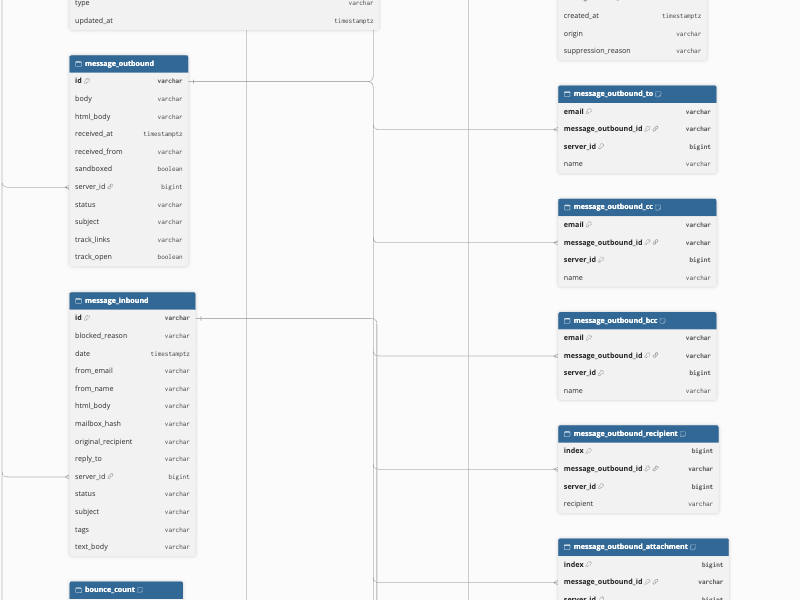
Hevo uses the following schema to upload the records in the Destination. For a detailed view of the objects, fields, and relationships, click the ERD.
Data Model
The following is the list of tables (objects) that are created at the Destination when you run the Pipeline:
| Object | Description |
|---|---|
| Bounce | Contains the bounces recorded for each server, including the bounce type, the email address and message that bounced, the time of the bounce, a description of the reason, and whether the address is inactive. |
| Bounce Count | Contains the number of bounces of each type, such as hard, soft, and transient, for each server and day. |
| Browser Usage | Contains the number of link clicks for each server and day, grouped by the browser family used, such as Chrome, Safari, Firefox, and Edge. |
| Browser Usage Platform | Contains the number of link clicks for each server and day, grouped by platform: desktop, mobile, and unknown. |
| Click Location | Contains the number of link clicks for each server and day, split by whether the link was clicked in the HTML or the text version of the email. |
| Domain | Contains the sending domains of your account, including their DKIM, SPF, and Return-Path verification details. |
| Email Client Usage | Contains the number of email opens for each server and day, grouped by the email client used, such as Apple Mail, Gmail, Outlook, and Yahoo. |
| Message Inbound | Contains the processed inbound messages received by each server, including the sender, subject, bodies, mailbox hash, status, and the reason if a message was blocked. It includes the child objects, Message Inbound Attachment, Message Inbound Cc, Message Inbound Header, and Message Inbound To. |
| Message Inbound Attachment | Contains the attachments of each inbound message, including the name, content type, and content length. |
| Message Inbound Cc | Contains the Cc recipients of each inbound message. |
| Message Inbound Header | Contains the email headers of each inbound message. |
| Message Inbound To | Contains the To recipients of each inbound message. |
| Message Outbound | Contains the outbound messages sent from each server, including the subject, status, bodies, link and open tracking settings, and the time Postmark received each message. It includes the child objects, Message Outbound Attachment, Message Outbound Bcc, Message Outbound Cc, Message Outbound Event, Message Outbound Recipient, and Message Outbound To. |
| Message Outbound Attachment | Contains the attachments of each outbound message. |
| Message Outbound Bcc | Contains the Bcc recipients of each outbound message. |
| Message Outbound Cc | Contains the Cc recipients of each outbound message. |
| Message Outbound Click | Contains the link click events of outbound messages, including the recipient, the clicked link, the click location, the email client, operating system, and platform used, and the geographic location. |
| Message Outbound Event | Contains the delivery events of each outbound message, such as the event type, recipient, receiving server and IP address, and a summary of the event. |
| Message Outbound Open | Contains the open events of outbound messages, including the recipient, the email client, operating system, and platform used, the geographic location, and the read time. |
| Message Outbound Recipient | Contains all the recipients of each outbound message. |
| Message Outbound To | Contains the To recipients of each outbound message. |
| Message Stream | Contains the message streams of each server, including archived streams, with the name, type, description, archive status, and unsubscribe handling settings of each stream. |
| Outbound Statistics | Contains the overall outbound email statistics of each server for the last 365 days by default, such as the number of emails sent, bounced, opened, and clicked, spam complaints, and the corresponding rates. |
| Platform Usage | Contains the number of email opens for each server and day, grouped by platform: desktop, mobile, webmail, and unknown. |
| Sender Signature | Contains the sender signatures of your account, including the email address, name, confirmation status, and the DKIM and Return-Path verification details of each signature. |
| Server | Contains the servers of your Postmark account, including the name, color, delivery type, inbound address, webhook URLs, and open and link tracking settings of each server. |
| Suppression | Contains the email addresses suppressed on each message stream of a server, along with the reason and origin of each suppression. |
| Template | Contains the email templates of each server, including the name, alias, type, subject, layout, and HTML and text bodies of each template. |
Additional Information
Read the detailed Hevo documentation for the following related topics:
Handling of Deletes
Hevo ingests all the records of the Domain, Message Stream, Outbound Statistics, Sender Signature, Server, and Template objects in each run. When a record is no longer in Postmark, Hevo sets the value of the metadata column _hevo_marked_deleted to True for the record in the Destination. If all the records of one of these objects are deleted in Postmark, Hevo marks them as deleted only after at least one record of that object exists again.
Hevo does not capture deletes for the other objects. Postmark does not let you delete messages, bounces, or events, and the messages that Postmark removes after the retention period remain in the Destination. If you remove a suppression in Postmark, the record remains in the Destination.
Source Considerations
-
Postmark keeps outbound and inbound messages, and their events, only for the retention period of your account, 45 days by default. Hevo cannot ingest messages that are older than this period. If your account has a longer retention period, select a matching Historical Sync Duration while creating the Pipeline, as you cannot change it later. Read How long are Inbound and Outbound messages stored in activity?.
-
Postmark returns at most 10,000 open or click events for each message stream in a query. If a message stream has more events, Hevo reads them by platform. Any events that remain out of reach are not ingested, and Hevo shows a warning for the object.
-
Hevo ingests only the inbound messages that Postmark has processed. Inbound messages that are blocked, scheduled for retry, or failed are not ingested. Postmark does not process the inbound messages of a server until an inbound webhook URL is set for it.
-
If Postmark does not return the Server API token of a server, Hevo skips that server and shows a warning for the object. For the Message Stream, Outbound Statistics, and Template objects, the ingestion job fails instead, so that Hevo does not mark the records of the skipped server as deleted in the Destination. The job succeeds once Hevo can read the server again.